By Thenesh Anbalagan and Ng Sze Fung
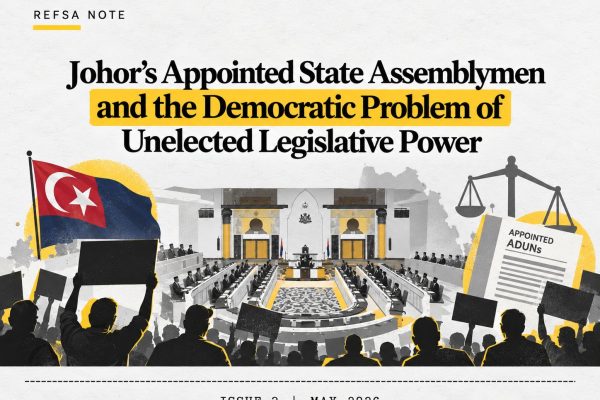
This note argues that Johor’s enactment to introduce up to five appointed ADUNs is fundamentally undemocratic because it allows unelected individuals to exercise legislative influence without a direct mandate from voters. While the Johor government frames the enactment as a way to bring expertise, professional experience and broader representation into the State Assembly, the central concern is that these appointees would not merely advise the legislature but may participate as members of the assembly. Expertise can be accommodated through select committees, advisory panels, public hearings and legislative research support without converting non-elected individuals into lawmakers. Political parties should also build technocratic capacity from within by identifying, recruiting, training and moulding experts, professionals and subject matter specialists, and eventually fielding them as electoral candidates. This would allow expertise to enter the democratic process with electoral legitimacy, thereby strengthening credibility, accountability and public trust. If the concern is under-representation, the more democratic remedy is redelineation rather than appointment.
The democratic risk is sharpened by Johor’s political arithmetic and constituency imbalance. The State Assembly currently has 56 elected seats, with BN holding 40. If expanded to 61 members through five appointed ADUNs, a coalition with 36 elected seats could still reach a two-thirds bloc of 41 seats with the help of appointees. At the same time, several Johor state seats already exceed 100,000 registered voters, including Kota Iskandar, Puteri Wangsa, Tiram, Permas, Skudai and Perling. This suggests that Johor’s representational challenge is better addressed by a redelineation exercise that reflects voter distribution and urban growth. Comparisons with Sabah, Terengganu and Pahang do not cure the democratic defect. The note concludes that Johor should not proceed with appointed ADUNs with voting power; it should instead strengthen committees, expert consultation, legislative research capacity and, where appropriate, pursue redelineation to correct malapportionment.